Outwit, outplay, and outlast your to-do list with GTD
If you're a fan of Survivor, you've probably imagined your perfect gameplay strategy. The game isn't just about surviving physically—it's about strategy, observation, and execution. You need to outwit, outplay, and outlast the competition.
This idea of strategy applies far beyond reality TV. It applies to your work, your projects, and even your personal life. Every day, you face a list of tasks and decisions, competing for your attention and energy. Without a strategy, you risk being blindsided by procrastination, missed deadlines, and overwhelm.
This is where Getting Things Done (GTD) comes in—a system designed to help you approach your tasks with the same strategic mindset a Survivor contestant would approach the game.
Why your to-do list needs a strategy
Imagine opening your to-do list in the morning. Emails, meetings, deadlines, side projects, personal errands—everything is clamoring for your attention at once. Without a clear approach, it's easy to find yourself jumping from one task to another without ever finishing anything. You might spend hours on low-priority work while the tasks that truly matter sit untouched. By the end of the day, even after checking off a few items, you feel mentally drained and frustrated.
This chaos is all too common, but it doesn't have to be your reality. With a system like GTD, you gain a clear framework for processing tasks efficiently. Instead of your to-do list dictating your day, it becomes a roadmap for action—a tool that helps you prioritize what truly matters, maintain focus, and move forward with confidence.
What is GTD?
GTD, or Getting Things Done, is a productivity framework created by David Allen, a leading expert in time and task management. At its core, GTD is designed to help you capture everything on your mind and move it into an organized system. Instead of trying to remember every task, idea, or deadline, you store it all in a trusted system that you can rely on.
The ultimate goal of GTD is achieving a “mind like water”—a calm, clear mental state where you can focus fully on the task at hand without being distracted by everything else swirling around in your head. By following this framework, you free yourself from mental clutter, reduce stress, and create a sense of control over your work and personal life.
The key idea is simple but powerful: you don't need to remember everything. You just need to capture it, clarify the next actions, and trust your system to guide you. When you do, your mind becomes a tool for focus and creativity rather than a storage space for endless to-dos.
The 5 Steps of GTD
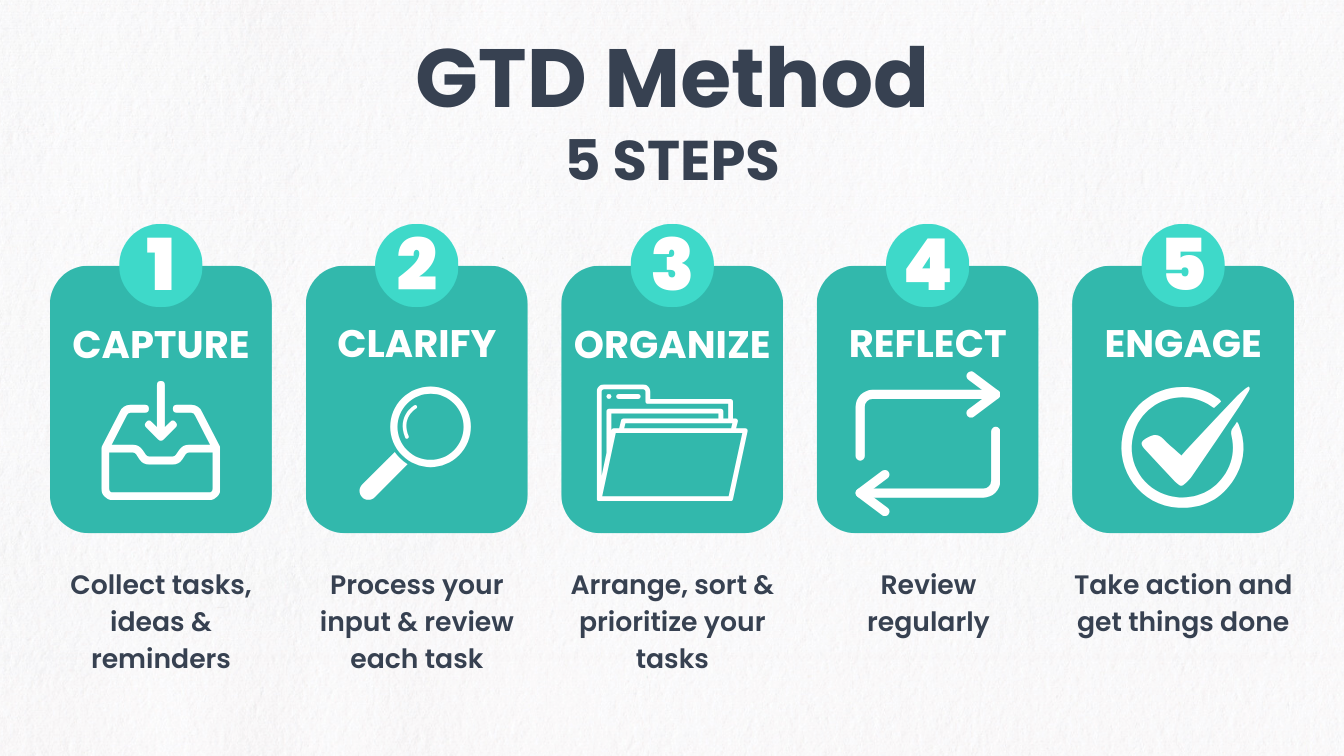
GTD works through five steps, which are simple but powerful when applied consistently:
The 5 steps of the GTD methodology are Capture, Clarify, Organize, Reflect, and Engage
1. Capture everything
Your mind is great at generating ideas, tasks, and reminders—but not so great at keeping them organized. GTD starts with a simple principle: capture every task, idea, or project as soon as it appears.
Think of it as a brain dump: emails you need to answer, ideas for your next blog post, errands to run, meetings to schedule. Once it's captured, you don't have to worry about forgetting anything.
To keep everything in one place, collect all your tasks, appointments, and ideas in an inbox. Time Stream's task list is perfect for this, acting as your central hub for anything that needs attention. You can even assign a status called “Inbox” to tasks that haven't been processed yet.
2. Clarify your tasks
Once you've captured everything, the next step is to clarify what each item actually requires. A vague “start project” doesn't help; you need to break tasks down into clear, actionable steps.
Start by reviewing and processing everything you've collected in your inbox.
For each item, ask yourself:
What kind of task is this?
Is it actionable?
What's the very next step I need to take?
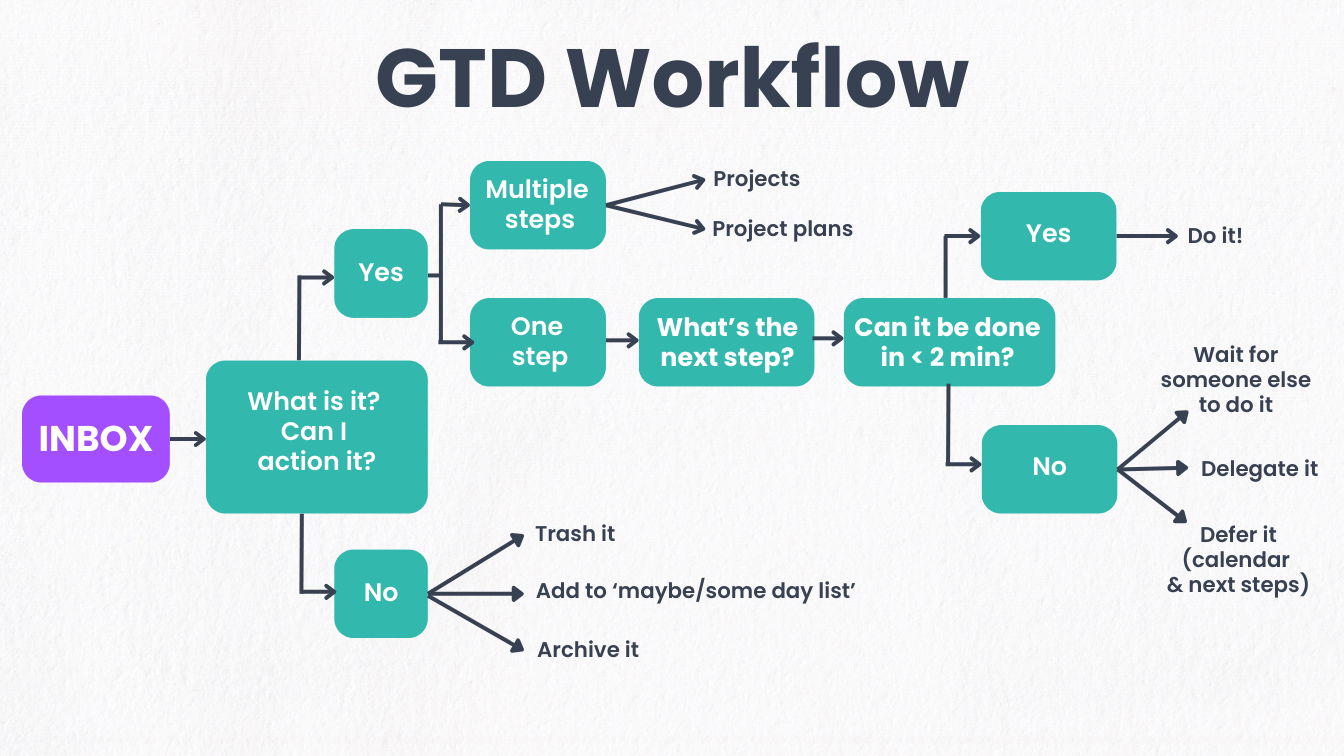
If an item can be completed in two minutes, do it immediately. If someone else can handle it, delegate it. And if it's a larger project, define the first actionable step so you can move forward without hesitation.
Some items might not require immediate action. In those cases, you have three options: you can trash it, add it to a “Maybe/Someday” list for future consideration, or archive it for reference.
Clarifying your tasks in this way removes friction, eliminates indecision, and prevents the “where do I start?” paralysis that often kills productivity. By processing your inboxes and defining clear next actions, you set yourself up for a smooth, focused workflow.
In GTD, once tasks are captured in your inbox, each item is clarified, ensuring every entry has a clear next step.
3. Organize efficiently
Now that you know exactly what each task entails, it's time to organize. Assign tasks to categories, projects, or contexts, and prioritize based on importance and deadlines.
For example, tasks can be categorized by priority: high-priority items due today, like responding to client emails or submitting a report; medium-priority tasks due later in the week, such as planning next month's social media calendar; and low-priority or optional tasks, like researching new tools.
With a clear organizational structure, you can glance at your to-do list and instantly know what to tackle next, instead of guessing or relying on willpower.
Pro tip: Use Time Stream's categories and statuses to group tasks, and note deadlines so nothing falls through the cracks.
4. Reflect regularly
Even the best systems need regular review. Set aside time daily or weekly to reflect on your tasks: what's done, what's next, whether your priorities are still accurate, and if there's anything you can delegate or remove. This practice keeps you proactive rather than reactive, ensuring you're not just crossing items off a list but actively managing your workload and energy.
5. Engage and take action
Finally, it's time to execute. With everything captured, clarified, and organized, you can focus on doing the work without mental clutter.
The GTD system allows you to choose tasks that match your current energy and availability. Short on focus? Handle simple, quick tasks. Feeling energized? Tackle a major project. Group similar tasks together in Time Stream to create productive blocks of focus. Your system isn't just about planning—it's about enabling smooth execution.
GTD in action: a simple example
Imagine you're organizing a weekend workshop. Without a system, the process can quickly become chaotic: you might stress over registration numbers, jump between booking a venue, sending emails, and creating materials, forget key details like catering or guest speakers, and end up rushing tasks at the last minute.
With GTD, the process becomes much more manageable:
Capture: List everything involved in the event—booking venue, sending invites, arranging catering, preparing materials, scheduling speakers, and promoting the workshop.
Clarify: Break each step into actionable tasks: “Confirm venue availability,” “Design invitation email,” “Order lunch boxes,” or “Prepare presentation slides.”
Organize: Assign due dates, priorities, and categories. For example, venue booked by Tuesday, invitations sent Wednesday, materials ready by Friday.
Reflect: Review progress daily. Adjust deadlines or shift priorities if tasks are taking longer than expected.
Engage: Focus on one task at a time, knowing all other steps are accounted for in your plan.
The result? The event runs smoothly, stress is reduced, and nothing important is overlooked. GTD transforms complex projects into structured, achievable plans, giving you clarity and control no matter how big the challenge.
Why GTD works better than “winging it”
Many people think they can just “keep track” of tasks in their head or jump between items as inspiration strikes. The truth? It rarely leads to real progress. You end up juggling too much, forgetting important details, and feeling drained at the end of the day. GTD works because it doesn't just organize tasks—it frees your mind, giving you clarity on what actually matters and the confidence to take action. By breaking projects into concrete, manageable steps and creating a system you can rely on, GTD turns overwhelm into control. When you use it consistently, you don't just get things done—you get the right things done, without the stress and chaos.
Final thoughts
Your to-do list doesn't have to be a source of stress. When approached strategically, it becomes a roadmap for action, growth, and productivity. GTD gives you the tools to capture, clarify, organize, reflect, and engage—so you can focus on what truly matters instead of spinning your wheels.
Start small: capture everything on your mind today, break tasks into actionable steps, and set priorities. Regularly reflect on your progress and adjust as needed. The cumulative effect of these steps is powerful—over time, you'll notice less mental clutter, smoother workflows, and more consistent productivity.
Think of your work like a game: play with intention, plan your moves, and stay focused on the bigger picture. Each task completed strategically is a win, and each win builds momentum toward your larger goals.
With a clear system in place, you're no longer at the mercy of chaos. You're in control—and that's how you truly outwit, outplay, and outlast your to-do list.
More from the blog
Find your flow, take your productivity to the next level.
When it comes to productivity, many assume success comes down to sheer willpower and motivation. But research shows that relying on it alone often leads to inconsistency. The real secret is pairing discipline with effective systems that support long-term consistency. In this post, we’ll explore how the two work together to help you stay productive and achieve lasting results.
In our fast-paced world, multitasking feels essential—replying to emails in meetings or switching between tasks seems efficient. But research shows it hampers focus, lowers work quality, and invites mistakes. Let’s explore why multitasking fails and how single-tasking can boost productivity.
In today’s fast-paced world, productivity is more important than ever. Yet, staying productive isn’t always easy. With the correct tools, staying on track becomes easier. Read on to find out how Time Stream will help you overcome five productivity challenges.
|
7 min
Find your flow. Start using Time Stream today.
The only productivity app that protects your time and privacy. Focus better, accomplish more.