The power of habit stacking: turning small changes into powerful productivity systems
When people think about productivity, the mind often jumps to big, dramatic shifts. We imagine tearing down our old routines, redesigning entire workdays, or setting strict new rules about when and how we'll focus. But in practice, these sweeping overhauls rarely stick. They demand too much willpower at once, and eventually, the old habits creep back in. True transformation usually begins with something much smaller—tiny, almost invisible changes that, when compounded, have the power to reshape the way we live and work.
This is the heart of habit stacking, a concept grounded in behavioral science and proven to make lasting change possible. Instead of trying to invent entirely new routines, habit stacking teaches us to anchor new behaviors onto the ones we already do without fail. It's not about sheer discipline or forcing yourself into brand-new patterns. It's about working with your brain's natural wiring to create momentum that grows over time.
Why habits matter so much
Before diving into the method of habit stacking, it's important to understand why habits are so central to productivity in the first place. Research has shown that around 40% of our daily actions are habits—automatic behaviors we perform with little thought. This means that nearly half of our day runs on autopilot, guided not by conscious choice but by routines we've already established.
That's good news and bad news. On one hand, habits free up cognitive energy. We don't need to actively think about brushing our teeth or unlocking our phones—they just happen. On the other hand, this automatic nature means unhelpful habits—like checking social media the moment we sit down to work—can sneak into our routines just as easily as helpful ones.
What this reveals is that motivation, the thing most of us assume we need to be productive, isn't always the reliable driver we think it is. Willpower depletes quickly throughout the day. The more decisions we make, the more drained we become. But habits bypass this energy drain because they're triggered by context, not motivation. That's where stacking comes in: it uses the context of habits you already have to give new, positive behaviors the best chance of sticking.
Understanding habit loops and habit stacking
Habit loops
When it comes to building better habits, one of the most powerful frameworks to understand is the habit loop. Introduced by Charles Duhigg in The Power of Habit and refined by James Clear in Atomic Habits, the habit loop explains why we do what we do—and how we can make routines work for us instead of against us.
1. Cue: the trigger The cue is what tells your brain it's time to act. Example: You sit down at your desk in the morning, ready to start your day.
2. Craving: the motivation The craving is the desire or feeling that pushes you to take action. Example: You want to feel organized and focused for the day ahead.
3. Reward: the payoff The reward is the benefit you will get from completing the habit-it satisfies your craving. Example: You feel clear-headed and motivated after writing down your priorities.
4. Response: the habit/action This is the habit (the action you actually take in response to the cue, craving, and reward). Example: You sit down at your desk in the morning, ready to start your day.
There's also a chemical boost at play. Completing a small habit triggers a release of dopamine, the brain's reward neurotransmitter. This makes the action feel satisfying and increases the likelihood you'll repeat it, reinforcing the chain and gradually building momentum over time.
Habit stacking
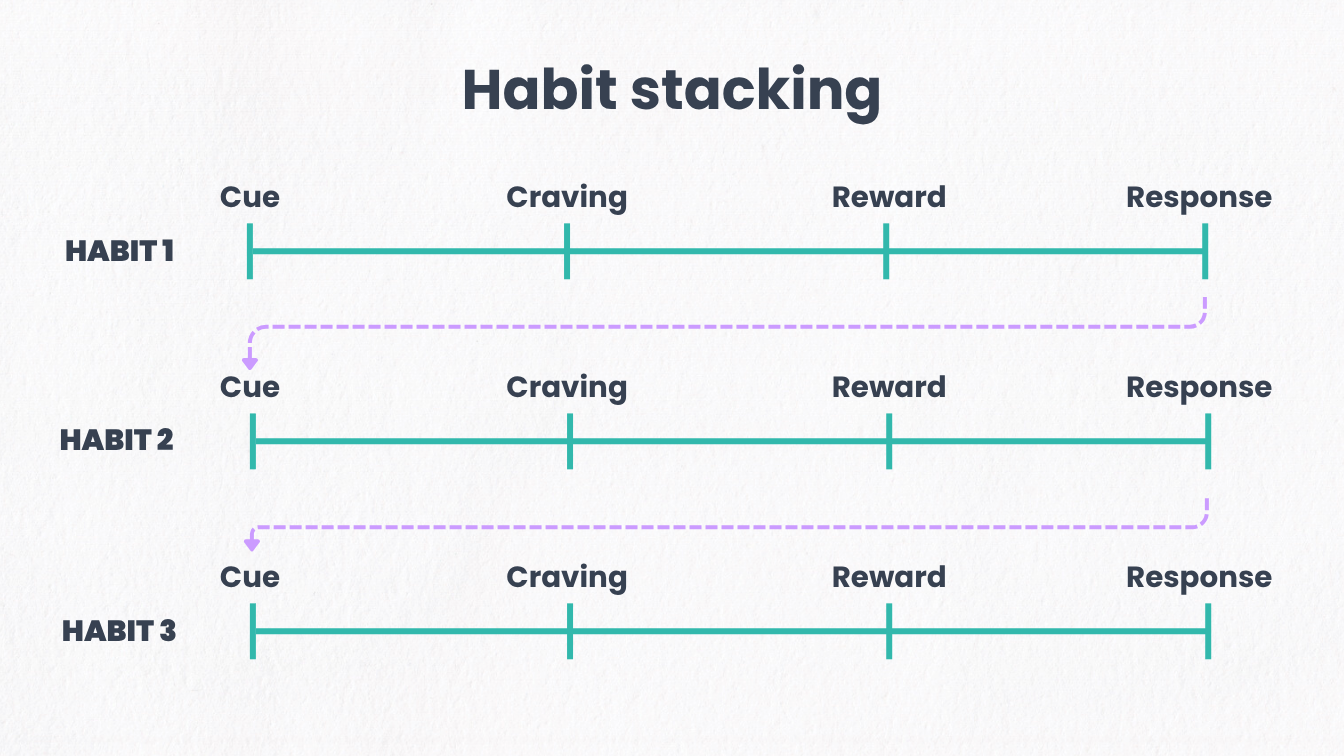
Once a habit is established, it can naturally trigger a second habit, a concept known as habit stacking.
Habit stacking is elegantly simple. Instead of forcing yourself to start new habits from scratch, you attach them to behaviors you already do reliably. For example, if you make coffee every morning without fail, that act becomes a natural anchor for another action: once the coffee is ready, you sit down and review your top three tasks for the day.
Existing habits serve as cues for new habits.
In other words, your existing habits become cues—hooks you can hang new routines on. Because your brain is already wired to remember and perform the first habit, the new one gets pulled along for the ride.
You can then add a third, and even a fourth habit. Each new habit piggybacks on the previous one, using the reward or feeling from the first habit as the cue for the next. Over time, these linked habits form a smooth, automatic routine.
Example sequence:
Habit 1: Having your morning coffee.
Habit 2: Making a healthy breakfast.
Habit 3: Writing your top three tasks for the day.
Habit 4: Starting your first 25-minute focused session of the day.
Eventually, your brain runs the entire sequence automatically, turning a series of small habits into a seamless flow. This is why researchers like BJ Fogg and James Clear emphasize the simple formula: “After I [current habit], I will [new habit].”
It's deceptively simple but incredibly powerful. Instead of relying solely on willpower, you're leveraging behaviors that are already automatic to build new habits effortlessly. Instead of relying on discipline for each individual habit, the chain itself guides your behavior automatically. By thinking in terms of systems rather than isolated habits, you can transform small, simple actions into routines that create real, lasting impact on your productivity and wellbeing.
Using Time Stream to supercharge your habit stacks
Habit stacking works best when paired with tools that fit naturally into your daily routine. Time Stream does exactly that. Instead of overwhelming you with endless options, it provides just what you need: a simple timer, a place to track tasks, and a space to reflect at the end of the day. It's built to support your habits, not complicate them.
Picture your workday starting like this: you sit at your desk, open Time Stream, and launch a 25-minute focus timer. That single action becomes the cue for focused work. When the session ends, you follow it with a quick reset—a stretch, a sip of water, or a brief pause away from the screen. This rhythm of focused effort and intentional breaks soon becomes automatic, turning small actions into a reliable, productive flow.
Time Stream doesn't just help during work hours. At the end of the day, you can review your progress on the Today screen, quickly seeing how much you accomplished. You compare the estimated Pomodoros for each task with what it actually took, giving you immediate insight into your planning accuracy and where you might adjust effort in the future. This nightly reflection becomes a habit that closes the day with clarity, while also helping you plan more realistic and effective focus sessions over time.
These small moments add up. With Time Stream, habit stacking not only keeps you on track, but it also builds awareness. You start to notice patterns: when you're most focused, which tasks consistently drain you, and where time tends to slip away. Awareness leads to insight, and insight leads to refinement—your system evolves naturally, without forcing it.
By combining habit stacking with Time Stream, everyday routines transform into anchors for deeper focus, smoother workflows, and meaningful reflection—turning ordinary habits into powerful, sustainable productivity.
The power of starting small
It can feel underwhelming at first to think that something as simple as writing down a task after pouring coffee could be the spark for real productivity. But that's the point: the science of habit stacking shows us that change doesn't need to be dramatic to be effective. In fact, the smaller and easier the action, the more likely it is to stick—and once it sticks, it grows.
Big transformations aren't just built on sudden bursts of motivation. They're built on the quiet, consistent layering of one habit onto another, until the stack becomes a system and the system becomes second nature.
If you've ever tried and failed to overhaul your routines in the past, habit stacking offers a gentler, more sustainable path. Instead of starting from scratch, you start from where you already are, and you let progress build naturally.
Final thoughts
Productivity doesn't come from rigid systems or superhuman discipline—it comes from designing your environment and routines in a way that makes good choices the default. Habit stacking is one of the simplest and most effective ways to do that.
By anchoring new behaviors to the habits you already rely on, you create small but powerful chains that grow into systems over time. With the right tools, like Time Stream, those systems become even easier to manage, helping you stay focused, track your progress, and reflect on your growth without added complexity.
In the end, habit stacking reminds us of a truth we often forget: you don't need to change everything to change everything. Start small. Build gradually. And watch as those tiny actions transform into powerful productivity systems that carry you forward day after day.
More from the blog
Find your flow, take your productivity to the next level.
When it comes to productivity, many assume success comes down to sheer willpower and motivation. But research shows that relying on it alone often leads to inconsistency. The real secret is pairing discipline with effective systems that support long-term consistency. In this post, we’ll explore how the two work together to help you stay productive and achieve lasting results.
Being productive is a goal many of us chase. But sometimes, the advice we follow is actually doing more harm than good. From hustle culture to multitasking, it’s easy to fall for myths that feel productive but lead to burnout and distraction. In this blog, we’re busting seven productivity misconceptions and showing you what to do instead.
Ever get so immersed in a task that time flies, and you forget to even check your phone? That’s productivity flow—a powerful state of deep focus that can boost your output by up to 500%. In this blog, we’ll explore what flow really is, why it matters, and how you can tap into it more often to work smarter, not harder.
|
5 min
Find your flow. Start using Time Stream today.
The only productivity app that protects your time and privacy. Focus better, accomplish more.